Français
 Italiano
 Español
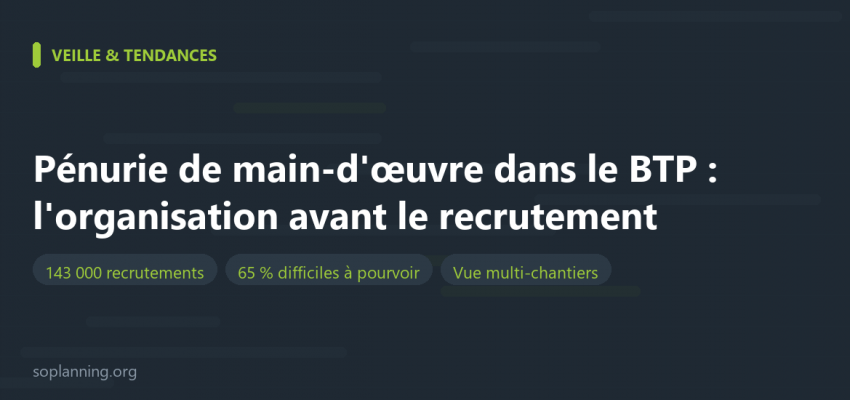
France Travail’s 2026 labour needs survey contains two figures for construction that appear to contradict each other. The sector reports around 143,000 planned hires, down 16.4% year on year. At the same time, 65% of those projects are rated hard to fill, a record level.
Fewer hires planned, more difficulty making them. That apparent paradox says something precise about the nature of the problem, and about where to look for room to manoeuvre.
What the figures say, and what they do not
First, the gap in perspective. Across the French economy, the 2026 survey counts nearly 2.3 million hiring projects, down 6.5%, with 43.8% rated difficult against 50.1% the previous year. Tension is easing nearly everywhere, except where you are: construction sits 21 points above the national average.
Two reading cautions, which matter if you are building a decision on this. The survey measures declared intentions, not completed hires, and France Travail itself notes that actual recruitment often exceeds announced projects. And a fall in intentions does not mean a fall in activity: it may equally reflect firms that have given up looking.
The occupations are the familiar ones: bricklayers, carpenters, electricians, and site managers on the supervisory side. This is not a cyclical blip but a structural shortage, driven by retirements and by a shortfall in initial training for technical trades.
Why recruiting does not solve the short term
Suppose you find the person. Between the decision to hire and the point where they are genuinely productive on site, weeks pass, sometimes months for a supervisory role. Meanwhile someone has to train them, which means an experienced colleague partly withdrawn from production.
Recruitment is an investment with deferred return, in a context where the need is immediate. It remains necessary. But if it is your only lever, you absorb the shortfall for the whole of that delay.
The lever with immediate effect is organisation. Not because your crews work badly, but because in construction the value leaks out of coordination far more than out of execution.
Three sources of slack, by yield
Waiting time between trades. The biggest loss, and the most invisible because it appears on no invoice. A crew arriving at an unprepared site, a drywaller waiting on the electrician, a delivery two days late that nobody passed on to the trades downstream. Every hour lost there is skilled labour you pay for without producing, in a context where skilled labour is exactly what you are short of.
The arithmetic is within any director’s reach, which is exactly why it is worth doing once. Take six tradespeople, one hour of waiting per person per week, forty-five working weeks: that is 270 hours a year, close to two months of one full-time tradesperson. One hour a week is a conservative assumption in most firms. That volume cannot be recruited, it can only be recovered.
Visibility on skills you already have. Many firms under-use certifications and qualifications already on the payroll, simply because nobody holds a consolidated view of who can do what. Work gets subcontracted that someone on the neighbouring site could have taken. This one costs nothing to exploit: it only requires the information to live somewhere other than in the site manager’s memory.
Equipment. Same logic, easier to quantify. A platform lift idle for three days on one site while another is rented for the site next door shows up immediately once both schedules are on one screen. It never shows up while they sit in two separate spreadsheets.
What this means for your schedules
- Anticipate needs three to six months out, not when the site starts. A need spotted early leaves a choice between hiring, agency staff, subcontracting and redeployment. Spotted late, only agency staff remains, at a premium.
- Build in explicit slack rather than scheduling to the hour. In construction the unexpected is the rule: weather, deliveries, rework. A schedule with no slack is not optimistic, it is wrong.
- Cross-check qualifications, availability and rest periods together, not one after the other. An assignment that ignores a statutory rest will be paid for later, and not only in money.
- Keep a multi-site view. That is where the first two sources of slack become visible. Site by site everything looks optimised; duplication only appears at company level.
- Make the schedule readable from site. A schedule crews have to phone the office about is not a shared schedule, it is a private one with a helpdesk.
What anticipation changes about negotiation
A side effect rarely anticipated: visibility on your schedule shifts your position with agencies and subcontractors.
A need raised the day before is paid at the emergency rate, and you take the available profile rather than the right one. The same need raised six weeks out can be negotiated, compared, and leaves time to check certifications. The price gap is real, but it is not the main point: what matters is that you choose instead of absorbing.
Same logic with subcontractors. A schedule shared with your regular partners, however rough, lets them line up their own crews and mechanically reduces the cascading slippage you end up receiving.
The real obstacle is not technical
In many construction firms the schedule genuinely exists, but it lives in one or two people’s heads. That works, sometimes remarkably well, until one of them is off sick, leaves, or is simply on another site when a decision is needed.
Getting the schedule out of that head is a change of habit more than an IT project. The classic trap is trying to tool everything at once: start with a single need, typically the multi-site view of crews, and add resources and locations only once the first use has stuck.
For framing deadlines, a retro-planning template is a sturdier starting point than a spreadsheet rebuilt for every job. For the field, the mobile app puts the schedule in the crews’ pockets, and compatibility across all devices avoids imposing particular hardware on people who already have a phone.
If this concerns you directly, open a 30-day trial and build a real schedule rather than a theoretical demo. No credit card required.
Source: Besoins en main-d’œuvre 2026 survey, France Travail.